






For many Australian Veterans, chronic pain is an unwelcome part of everyday life. Whether it’s the result of physical injuries sustained during service, repetitive strain over the years, or stress-related conditions that have taken a toll on both body and mind, pain often continues long after the uniform is folded away.
What’s more frustrating is that many veterans feel like they’re left to manage it alone. That’s where Calmed Forces can help.
If you’re a DVA Card holder, you may be eligible for fully funded pain management services, with no out-of-pocket expenses. These services focus on long-term solutions to help you regain control of your health, mobility, and overall quality of life.
Chronic pain is defined as pain that lasts more than three months. For veterans, this can stem from a wide range of causes:
Pain doesn’t just affect your body; it impacts how you sleep, how you move, and how you interact with the people around you. It’s more than just a medical issue; it’s a barrier to living the life you want.
This support program is designed specifically for Australian veterans. We connect you with Calmed Forces: a national network of medical and allied health professionals who are experienced in veteran care.
Services are tailored to your needs and may include:
Physiotherapy to reduce stiffness and improve function
Many veterans aren’t even aware of what’s available to them. Calmed Forces helps take out the guesswork and gets you started.
Even while you’re waiting for professional support, there are simple steps you can take to manage pain more effectively at home:
1. Stay Physically Active (When You Can):
Movement helps keep joints and muscles flexible and prevents stiffness. Even light walking or stretching can make a big difference over time.
2. Practice Pacing:
Push too hard on your good days and you may crash on the next. Learn to listen to your body and pace yourself. Balance is key.
3. Track Your Symptoms:
Keeping a pain journal can help you understand what triggers flare-ups. This information can also be incredibly useful for your healthcare provider.
4. Address Mental Health:
Chronic pain and mental health go hand-in-hand. If you’re feeling anxious, frustrated, or down, it’s okay to speak up. A trained psychologist can help you develop coping mechanisms that make the pain easier to live with.
5. Sleep Smarter:
Poor sleep can make pain worse. Try to establish a regular sleep routine, limit screen time before bed, and speak to a professional if sleep is a struggle.
Veterans have a unique set of experiences and they deserve care that reflects that. From the physical demands of service to the psychological weight of trauma, your pain story is different.
That’s why Calmed Forces only partners with practitioners who understand military service and take a whole-person approach to pain management. You’re not just a number. You’re a veteran, and you deserve to be heard.

Life after service comes with its own set of challenges. The routine, structure, and teamwork that once shaped your days

For many Australian veterans, managing weight after service is a real struggle. Years of physical wear and tear, changes to
Here at Veteran Benefits Australia, (we, us, our, or Veteran Benefits Australia) protecting your privacy and treating your personal information with care is of paramount importance to us. This Privacy Policy explains why we collect personal information and how we collect, use, disclose, store and protect your personal information when you use our Veteran Benefits Australia Services (our referral services to third party suppliers of goods and services to veterans and anything we add to those services from time to time).
It also explains how to contact us to correct, update or delete any personal information provided to us, or make a complaint if you have concerns. We are compliant with the privacy principles of Australia.
We will only collect and process personal information about you where we have a lawful basis to do so. Lawful basis includes consent (where you have given consent such as filling out our “contact us” form), contract (where processing is necessary for the performance of a contract with you) and legitimate interests (including security threats or frauds, compliance with applicable laws, and enabling us to administer our business).
You expressly and voluntarily grant your informed consent to Veteran Benefits Australia to deal with your personal information in accordance with the terms and conditions of this Privacy Policy. You have the right to withdraw or decline your consent at any time and where we rely on legitimate interests, you have the right to object.
We will notify you about any changes to our Privacy Policy by updating the “Last updated” date of this Privacy Policy. You are encouraged to periodically review this Privacy Policy to stay informed of updates. You will be deemed to have been made aware of, will be subject to, and will be deemed to have accepted the changes in any revised Privacy Policy by your continued use of the Veteran Benefits Australia Services after the date such revised Privacy Policy is posted.
This Privacy Policy applies to Veteran Benefits Australia with respect to the Veteran Benefits Australia Services.
Personal information is defined as information or an opinion (including information or an opinion forming part of a database), whether true or not, and whether recorded in a material form or not, about an individual whose identity is apparent, or can reasonably be ascertained, from the information or opinion.
From time to time Veteran Benefits Australia may offer the ability to make a donation or purchase goods or services including merchandise through its Website. The terms of donation or purchase will be in accordance with the online check-out terms and conditions appearing on check-out of the transaction.
We may collect your personal information when required by law but generally we collect personal information from you (or about you) to allow us to:
Personal information collected or received by us will only be used for the stated purpose for which it was provided.
When you access the Veteran Benefits Australia Services, we may collect certain information automatically, including, but not limited to, your operating system, the type of Internet browser you use, unique device identifiers and other diagnostic data (Usage Data).
Your personal information will not be used contrary to this Privacy Policy but may be disclosed to third parties in the following circumstances:
If personal information is disclosed to a third party, we are required to take reasonable steps to ensure your personal information is treated in accordance with the laws that apply to personal information.
We collect most personal information directly from you when you make an enquiry about our Veteran Benefits Australia Services from us. Your consent may be express (e.g. you agree to the use of your information by ticking a box) or implied by an action you take or do not take (i.e. because you have agreed to terms and conditions that contain information about the use or disclosure of your information). At the date of this policy, your consent is given when you register your interest in a service, sign up for our newsletter or complete our contact us registration form.
You are not obligated to provide us with your personal information. You may choose whether you receive communications from us. Whilst it is your choice not to provide your personal information to us this may impede our ability to provide you with all of the functionality of our Veteran Benefits Australia Services.
Should you wish to remove yourself from our contact database you may do so at any time by contacting us at www.veteranbenefitsaustralia.com/contact-us/
At any time you may contact our Privacy Officer and request your personal information be modified. We will make all efforts to correct data once we have proved your identity.
We will deal with all requests for access to personal information as quickly as possible, but no later than 30 calendar days from the date of your request (unless any complexities arise).
We will refuse access where the personal information relates to existing or anticipated legal proceedings, and the information would not be accessible by the process of discovery in those proceedings. Further, we will refuse access where your request is frivolous or vexatious, and where we reasonably believe that: giving access would pose a serious threat to the life, health or safety of any individual, or to public health or public safety; unlawful activity, or misconduct of a serious nature, is being or may be engaged in against Veteran Benefits Australia and giving access would be likely to prejudice the taking of appropriate action in relation to that matter.
If we refuse to give you access we will provide you with reasons for our refusal, unless doing so would be unreasonable in the circumstances. We will also take reasonable steps to give you access in a way that meets your needs without giving rise to the reasons of our refusal. Further, we will provide details of how you may make a complaint about our decision.
Please note that the access and correction requirements under this Privacy Policy operates alongside and do not replace other informal or legal procedures by which an individual can be provided access to, or correction of, their personal information.
For us to provide excellent service we are required to store some personal information and take the greatest of care to ensure this information is treated as private and confidential. Transmitting personal data via the internet does have inherent risks associated with it. We will however take all reasonable steps to ensure the security of this data. Note that no information transmitted over the Internet can be guaranteed to be completely secure. While we will endeavour to protect your personal information as best as possible we cannot guarantee the security of any information that you transmit to us, or receive from us. The transmission and exchange of information is carried out at your own risk.
Although we take measures to safeguard against unauthorised disclosures of information, we cannot assure you that personal information that we collect will not be disclosed in a manner that is inconsistent with this Privacy Policy.
We have taken the necessary measures to ensure the personal information (including the financial information about yourself) we hold is not compromised. In accordance with and as permitted by applicable law and regulations we will retain your information as long necessary to serve you, to maintain your Veteran Benefits Australia registration or as otherwise need to operate our business.
It is important that you protect your privacy by ensuring that no one obtains your personal information and you must contact us directly if your details change. Should your information be erroneously provided to us or no longer remain valid within the constraints of this Privacy Policy we will securely destroy or de-identify it as soon as practicable, as long as it is lawful to do so.
We have obligations to notify you if you are affected by an data breach. We will take all reasonable precautions to take remedial action to prevent such an event. However, as we cannot guarantee that remedial action will be sufficient to prevent all instances of a breach, we will take steps to notify you of an eligible data breach as soon as practicable and provide recommendations as to what steps you should take to mitigate any serious loss or damage.
Cookies are text files placed on your computer to collect standard Internet log information and visitor behaviour information. When you visit our website, we may collect information from you automatically through cookies or similar technology.
Insofar as those cookies are not strictly necessary for the provision of our website and services, we will ask you to consent to our use of cookies when you first visit our website.
We use cookies in a range of ways to improve your experience on our website, including understanding how you use our website.
There are a number of different types of cookies, however, our website uses:
You can set your browser not to accept cookies, and the above website tells you how to remove cookies from your browser. However, in a few cases, some of our website features may not function as a result.
Our site has links to other websites and services provided on those websites not owned or controlled by us. These links are meant for your convenience only. Links to third party websites do not constitute sponsorship or endorsement or approval of these websites. Please be aware that we are not responsible for the privacy practises of other such websites. We encourage our users to be aware, when they leave our website, to read the privacy statements of each and every website that collects personal identifiable information.
Veteran Benefits Australia is in no way associated with the Department of Veteran Affairs. Veteran Benefits Australia is an online service providing an information blog that has affiliate agreements with its service providers. Veteran Benefits Australia is remunerated for its services from the service providers for the marketing and services it provides. Please note that some of the links on this website are affiliate links. This means that Veteran Benefits Australia will earn a commission if you decide to proceed with the service providers services they are providing. Please understand that I have thoroughly checked these service providers and I recommend them because they are helpful and useful for veterans, not simply because we make money from referring you to them. Please don’t proceed with these services if you don’t think they will benefit you or your family. Veteran Benefits Australia is purely designed to promote the awareness of these services and does not accept payments from veterans directly.
These are the terms and conditions of Veteran Benefits Australia. All advices, referrals and other services provided by Veteran Benefits Australia (“Services”) whether via its website at www.veteranbenefitsaustralia.com (“Website”) or by contacting Veteran Benefits Australia in any other manner, are provided on these Terms & Conditions and all customers of Veteran Benefits Australia’s Services (each a “Customer”) agree to these Terms & Conditions as a pre-condition of obtaining any Services from Veteran Benefits Australia. No terms and conditions introduced by the Customer shall take effect to vary these Terms & Conditions unless expressly agreed in writing by Veteran Benefits Australia.
Veteran Benefits Australia’s Services are an online service and information blog designed to connect Customers to third party service providers (“Service Providers”) to facilitate Customers’ awareness and access to possible useful services for veterans, whether at full or discounted prices, as described in the various service categories described on the Website.
Veteran Benefits Australia does not of itself provide any health care service, social security service, legal or financial advice or any other direct service of any kind.
Veteran Benefits Australia is not affiliated with the Department of Veteran Affairs or any other Government department, the Returned and Services League Australia (RSL) or any other veterans association.
Veteran Benefits Australia’s Services are an independent online service.
Whilst all care is taken to connect Customers with suitable, qualified and appropriate Service Providers based on the Customer’s instructions as to their needs, Veteran Benefits Australia does not endorse the advices of any Service Provider and expressly disclaims any liability for any products and services provided by Service Providers. Customers are encouraged to consider if the products and services of the Service Provider are suitable for the Customer’s needs and seek independent advice if required.
Veteran Benefits Australia will not conduct any assessments of the Customer’s needs and any recommendation that Veteran Benefits Australia makes for use of any Service Provider including for the making of any social security application, health care or other services is purely based on Veteran Benefits Australia’s response to the Customer’s request and their own assessment of their needs and circumstances.
From time to time Veteran Benefits Australia may offer the ability to make a donation or purchase goods or services including merchandise through its Website. The terms of donation or purchase will be in accordance with the online check-out terms and conditions appearing on check-out of the transaction.
The purpose of the following is to inform you about the provision of social worker services by Medilinks Australia Online Pty Ltd t/as VBA Health (“us”, “we” “VBA Health”) and for you to consent to receive social worker services from us and to our management of your personal information.
Type of Services
Social worker services include the following supports:
Collection of Personal Information
As part of providing social worker services to you, we need to collect and record personal information from you that is relevant to your situation, such as your name, contact information, medical history and other relevant information. This collection of personal information will be a necessary part of the services that are provided.
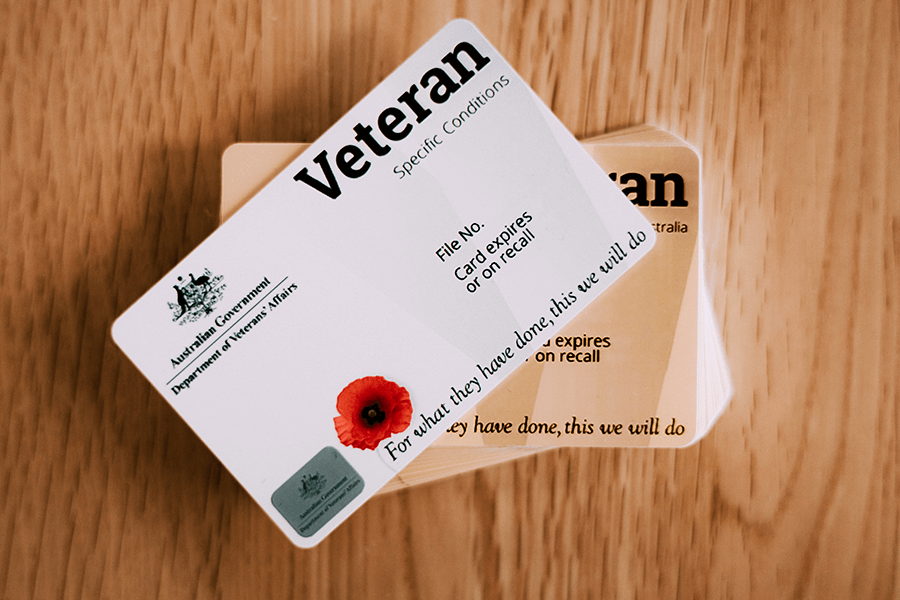
The following steps will help view the accepted conditions of your DVA white card via the MyGov website.
Go to https://my.gov.au
Sign in to your myGov account using your Username and Password.
You can sign in to myGov using the following:
After entering your login details you may be required to provide a one-time access code.
If you do not have a myGov account, you can create one by selecting Create myGov account on the myGov sign-in page.
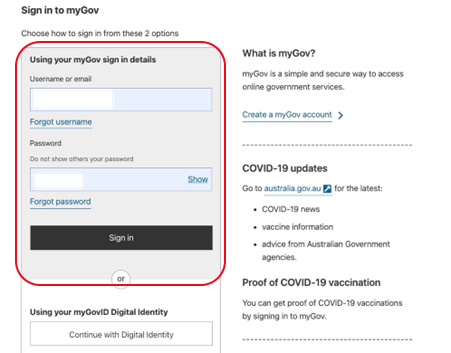
Sign-in using the MyGov login page
Once you have logged into your account scroll down until you see the heading ‘Your Services’.
Your Services lists the government programs you access that offer online services through myGov. You should see ‘Department of Veteran Affairs’ listed here.
Select ‘Department of Veteran Affairs’.
If you do not see Department of Veteran Affairs listed you will have to link this service to your account (See the video below).
You can do this by selecting Link another service.
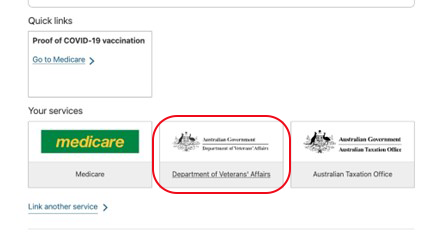
Select the DVA tile
This is your Department of Veterans’ Affairs My Service Home Page.
My Service allows you to access DVA services online such as:
Look in the middle column titled Claims.
Select Accepted Conditions.
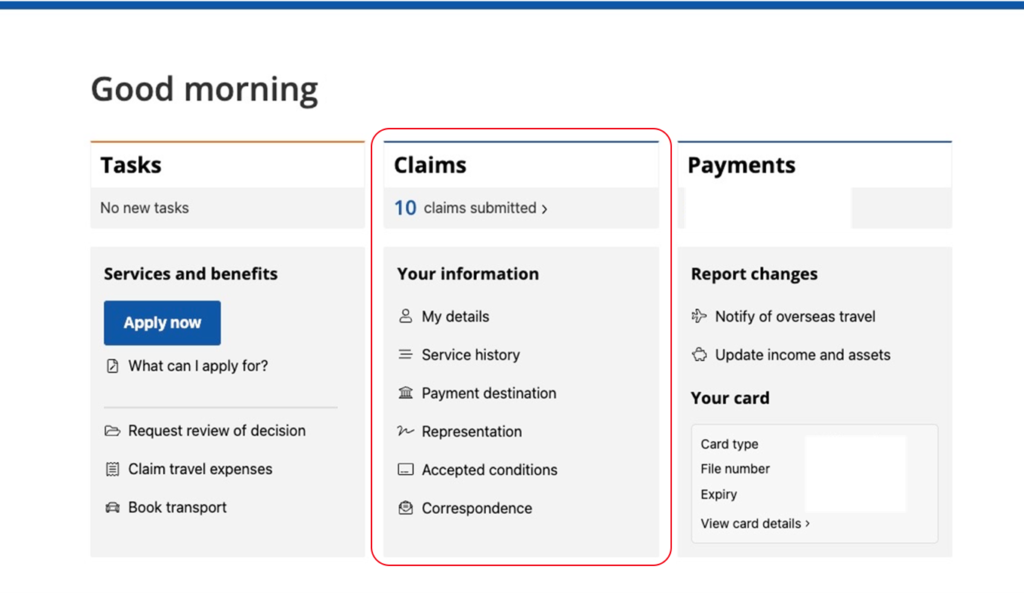
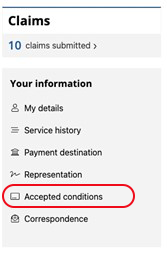
Select Accepted Conditions from the Claims Menu
This page shows your digital DVA Veteran Card.
You will see information such as your Card Number, Expiry, Card Type and the Conditions listed on your card.
Select the Conditions Listed drop-down menu to view the conditions listed on your card.
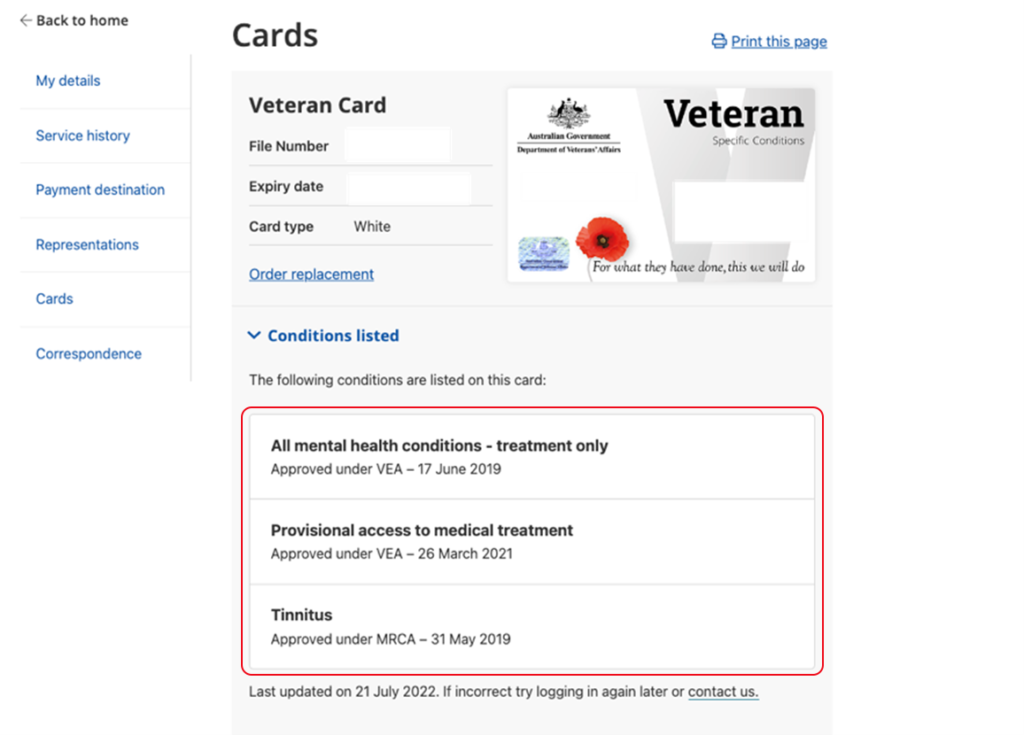
Select Print this Page in the top right-hand corner of the page to download your digital DVA Card as a PDF.
Alternatively, if accessing this on your mobile phone you can take a screenshot of this page. Depending on your phone you can:
Video on how to log on and link my service: